Progressive or Bifocal Lenses: Which Fits Your Day?
How bifocals and progressives differ, and which suits golf, reading and driving around town.
Why you need more than one power
Around middle age, the eye's lens gets less flexible, so close-up work gets harder. The National Eye Institute calls this presbyopia. It says presbyopia makes it hard for middle-aged and older adults to see things up close.
NEI describes glasses as the simplest and safest way to correct refractive errors. When you need one power for distance and another for reading, you have a few lens choices. This post walks through the two most common, so you can talk it over with your optician.
How bifocals work
A bifocal has two zones. First, the top holds your distance prescription. Then a small segment at the bottom holds your reading power. You can see the line where the two meet.
Bifocals are simple to understand. However, the jump between zones is sudden. Also, the middle distance can be a blur, like a car dashboard or a computer screen. Some people who want a clear, defined reading zone still like them. For that reason, a trifocal adds a third zone for arm's-length tasks.
Choosing is easier when you can try them. Ask our opticians to explain how each design would sit in the frame you like. Frame height changes how much reading zone you get.
How progressives work
A progressive lens has no visible line. Instead, the power changes smoothly from distance at the top, through an intermediate zone, to reading power at the bottom. So you get clear sight at many distances in one pair of glasses.
Because there is no line, the lens looks like ordinary glasses. Many people like that. However, the tradeoff is a learning curve. The sides of the lens have some blur. Because of that, you learn to turn your head a bit rather than just your eyes.
Which fits your day
First, think about what you do most. A few examples from life in The Villages:
- Golf: you look far down the fairway, then down at the ball and the scorecard. Progressives cover both, but tell your optician if you want the lens set up for golf.
- Driving a golf cart or a car: distance and the dashboard matter most. So a progressive covers both without switching glasses.
- Reading and crafts: a wider reading zone matters. A dedicated pair of reading glasses can be a good second pair.
- Computer and tablet: the intermediate zone counts, so ask about lenses made for screen distance.
There is no single right answer, because your habits decide it.
If you split your time between two homes, keep a spare pair in the second house. Switching between old and new prescriptions causes more headaches than most people expect. For that reason, retire the old pair once you adapt to the new one.
Getting used to new lenses
Most people need a few days to adjust. First, these habits help:
- Wear the new pair all day at first, not now and then
- Point your nose at what you want to see
- Move your eyes down to read, rather than lifting your chin
- Take care on curbs and steps for the first days
If something still feels off after the first week, come back. Then small changes to the fit, the nose pads or the frame height often fix it. Our opticians handle adjustments and repairs in the office.
Fit matters as much as the lens
A progressive needs careful measurements, including where your pupils sit in the frame. Also, a frame that slides down your nose can spoil a well-made lens.
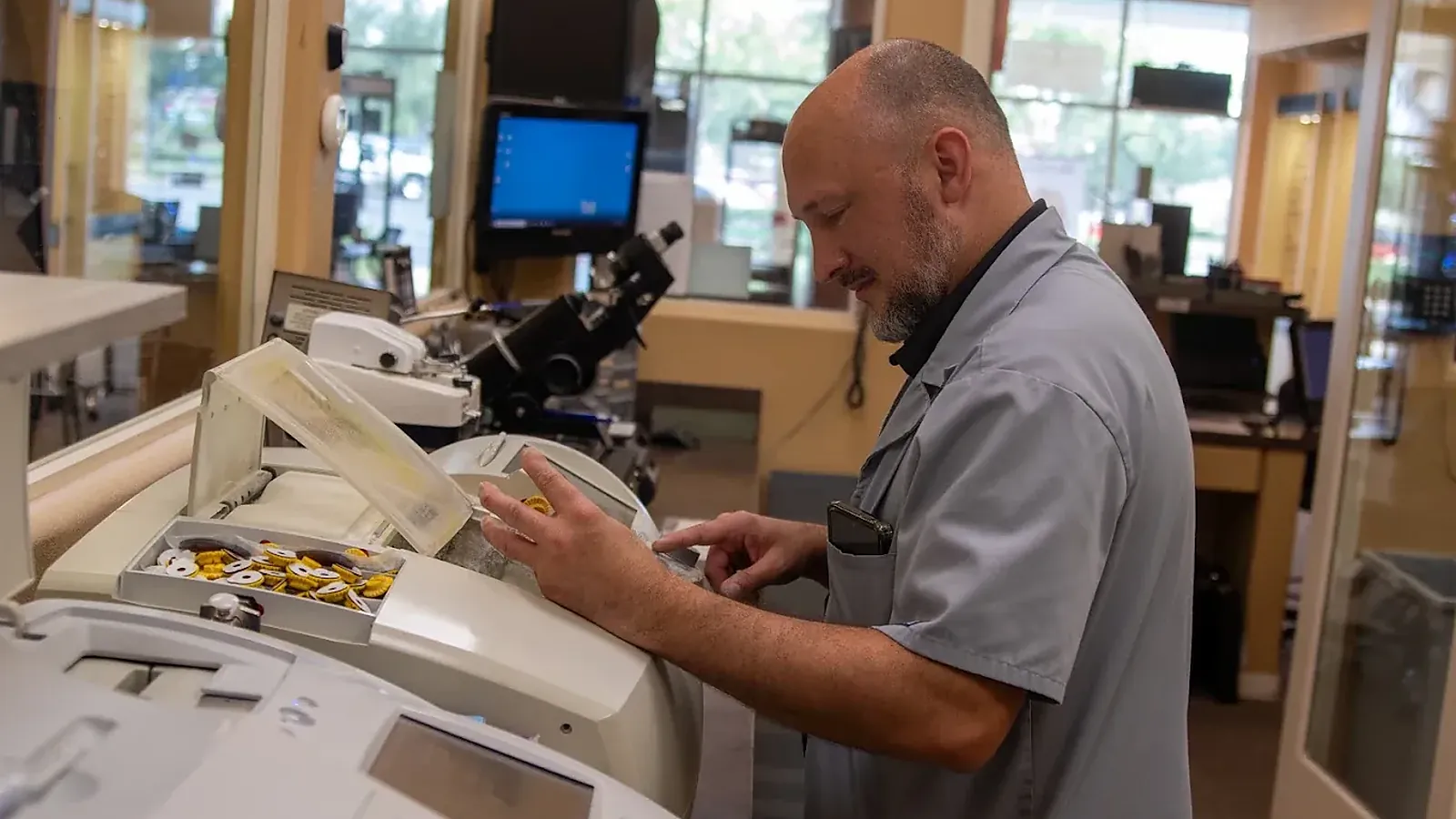
Our optical has thousands of frames in stock, and the on-site lab makes many glasses in about an hour. You can also add Transitions® lenses, which darken in sunlight, handy for a sunny Florida day.
Under the FTC Eyeglass Rule, you receive your prescription after the exam and may buy glasses wherever you choose. We would be glad to help you here, and you are never required to.
Ready for your visit? Request an Appointment or Call (352) 399-5412.
First, bring your current glasses to your visit. They help our opticians see what has worked for you and what has not. Tell them about your hobbies, too, from golf and bridge to painting and long drives.
Glasses made on site, many in about an hour
Get your eyes checked, pick from thousands of frames, and watch our lab cut your lenses. Your prescription is yours, and you may take it anywhere.